
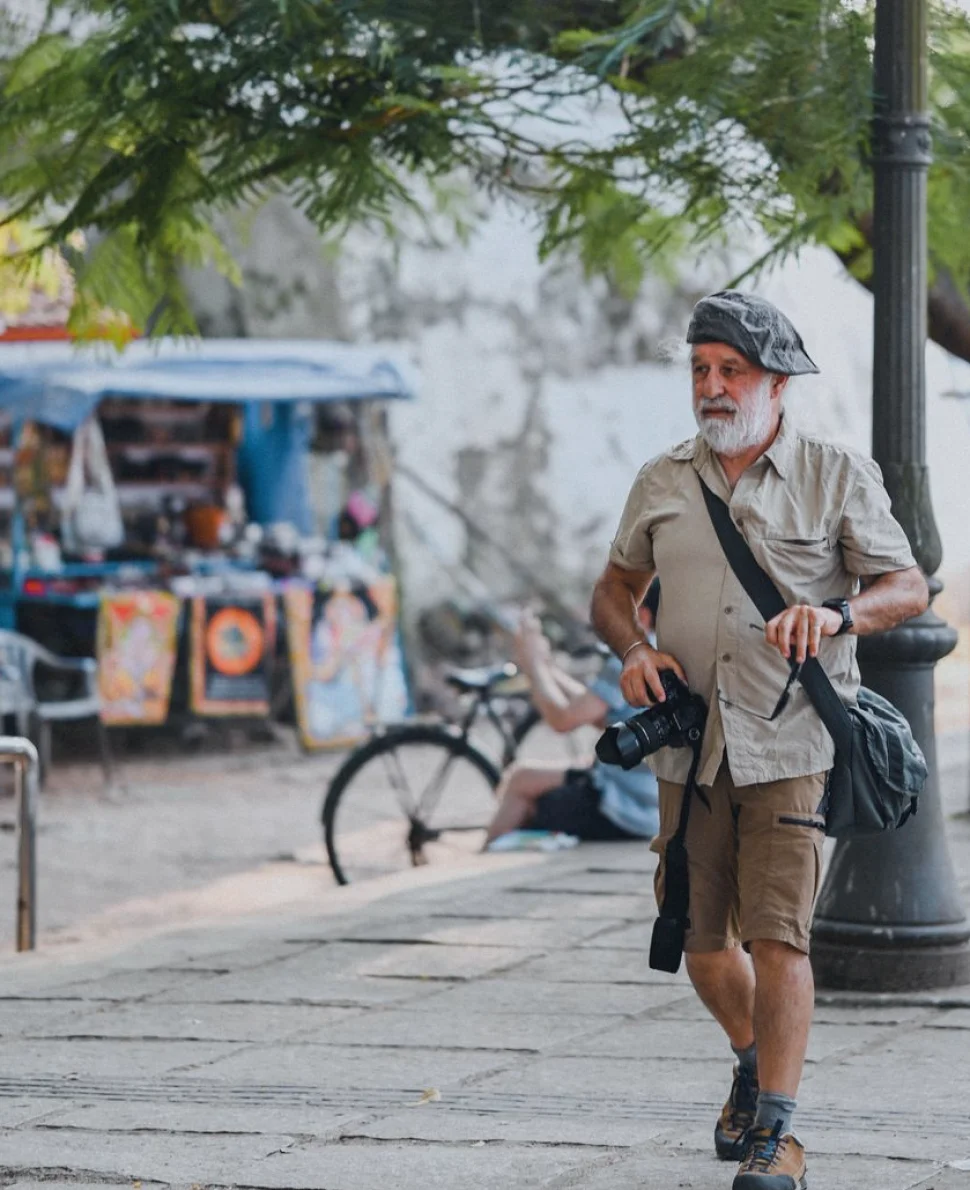
Two ways to stand in front of a lens
Most reporters who come to us arrive with a habit they did not choose. Some plant their feet and talk straight down the lens; others drift into a walk because they saw it on screen and assumed it was the modern way. Both are legitimate. The trouble starts when the choice is made by accident rather than by the story.
In these autumn weeks we are running a lot of outdoor exercises, so the question comes up daily. Which delivery should a newer reporter practise first: the static piece to camera, where you hold one position and speak, or the walking piece, where you move through the location as you talk? This note compares the two honestly and ends with a recommendation.
I coordinate the courses rather than teach them, so what follows draws on what our tutors tell me after each session and on what I see in the review sessions. It is a view from the side of the classroom, with the tutors' habits in mind.
The static piece to camera
A static delivery gives the reporter one job: speak clearly, with the right face for the story, to a frame that does not change. The camera operator can lock off, check exposure once and concentrate on audio. There is less to go wrong, and a mistake is usually a spoken one, which is easy to hear and easy to fix on the next take.
The weakness is that a held shot can feel like a reporter reading to an empty street. Without anything happening around you, the delivery has to carry itself, and nerves show quickly. Reporters often rush, stare too hard at the lens or blink more than they realise. A static frame forgives a wobbly location but not a wobbly voice.
It also suits difficult places: wind, a crowd behind you, a short time slot before a cue. When the setting is busy, standing still and keeping the framing simple protects the report.
- One position, one framing, one thing to rehearse
- Easier for the operator to light and monitor sound
- Exposes pacing and eye line very plainly
- Works well when the location is crowded or the time is short
The walking piece to camera
Moving through a place lets the picture do some of the explaining. If the story is about a closed footbridge, walking towards the barrier while you describe it puts the viewer in the scene. Done well, it feels natural and shows the reporter knows the ground. It also gives the script a shape, because each new thought can arrive with a new view.
It asks a good deal more. You must remember your words while watching your footing, keep the same distance from the lens and not drift out of the microphone's reach. The operator has to move with you, hold the framing and avoid trips, which is a real strain on handheld work. A line fluffed at the end means going back to the start of the walk.
So the walking piece rewards preparation and punishes improvisation. It is not harder because it is cleverer; it is harder because three things must go right at once.
- Puts the viewer inside the location
- Needs a rehearsed route and agreed marks with the operator
- Costs more takes when a line is missed
- Demands steady handheld work and clean audio on the move
What we see in the classroom
When reporters try both in a single session, the pattern is consistent. Those who start with the walking delivery tend to spend their attention on the movement and let the sentences go flat. Their words are fine on paper but arrive without emphasis. Those who start static usually find their voice sooner, then add movement with far less trouble.
There is also a team effect. In pairing exercises the operator learns from the static take how the reporter breathes and where the natural pauses fall. That knowledge makes the later walking take smoother, because the operator can anticipate where the reporter will slow down or glance away.
One more point from the tutors: confidence is built by finished takes. A static piece gets finished more often in a short session, and a reporter who has a clean take on the card walks into the harder exercise in a better frame of mind.
Our recommendation
Learn the static piece first, and learn it properly. Work on the opening line, the pace of the middle and a clear final sentence, then repeat it until you can deliver it without looking as if you are reciting. Practise it in different light and with different noise behind you, because a reporter who can stay composed in a bad location is worth having on any team.
Add the walking piece second, once the static delivery feels like your own. Begin with a few steps rather than a long route, agree your marks with the operator and walk the path without the camera before you shoot. Increase the distance only when the words are secure.
The walking shot should be chosen because the story needs movement, never because it looks professional. If you cannot say what the viewer gains from the walk, stay still.
- Start static and aim for three clean takes in a row
- Add short walking moves once the words are secure
- Rehearse the route without the camera first
- Choose movement only when the story gains from it
Choosing between them on the day
On location, the decision usually comes down to three questions. How much time do you have before the cue or the deadline? How safe and open is the ground you would be walking over? And does the story have somewhere to go, a place to move towards that shows the viewer something new?
If the answer to the first two is tight and the third is vague, hold your position and make the delivery count. If the time is there, the ground is clear and there is a real destination, a short walk can add something a static frame cannot.
Agree it with the camera operator before anyone presses record. A thirty-second conversation about marks, where you will stop and who gives the cue saves far more time than it takes, and it is the habit our pairing exercises try hardest to build.
Neither delivery is better in itself. The static piece builds the voice, the walking piece adds movement, and a reporter needs both in the end. Start with the one that lets you finish takes and hear your own pace, then add movement when the story and the ground allow it. If you want to practise both with a tutor watching, our on-camera reporting course covers them in that order, and the contact page is the place to ask about the next group.